


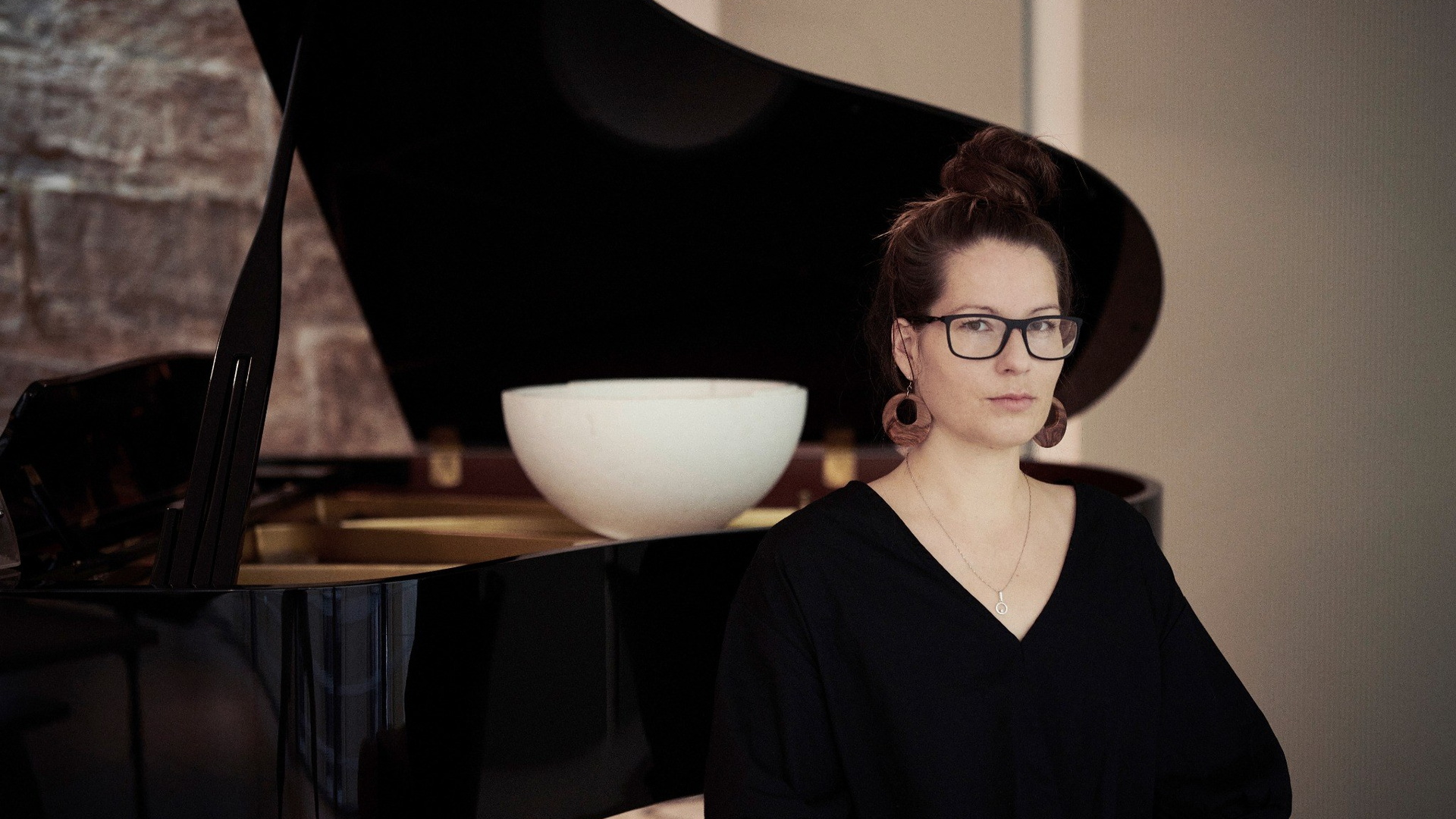
[Interview] The Subtle Magic of Petra Strahovnik
Interview with Petra Strahovnik, recipient of the Prešeren Fund Award and internationally acclaimed composer of contemporary music.
Petra Strahovnik hardly needs any
introduction, as her international successes continue to follow one after
another, and we regularly inform our readers about them. So let us immediately
go in medias res. Several years have passed since our last interview, and in
the meantime she has achieved a number of major successes: victory at the International
Rostrum of Composers, the opera BallerinaBallerina based on a libretto by Marko
Sosič, the Berlin Art Prize for Music and awards from the Akademie
der Kunste, an artist residency at Villa Concordia in Bamberg, and
this year she was among the recipients of the Prešeren Fund Award. All
this points to exceptional artistic strength and to the fact that the
international public has recognized the importance of her work.
In your work you draw on an
interdisciplinary foundation, something we already discussed in connection with
the project Through the Looking Glass. It consists of five works describing
different psychological states and was performed, in collaboration with Jürgen
Fritz, in several galleries in The Hague. How did you make the journey from
idea to realization? After all, this is a very demanding area - the portrayal
of mental disorders - and your work encourages immersion in their state and
empathy.
Yes, it was a very long process. Bold, demanding, mentally and emotionally fulfilling and exhausting at the same time. First it was necessary to form a team that deeply felt the message of the project: specialists such as the performance artist Jürgen Fritz and the psychologist Christina Bouwkamp, as well as musicians who were willing to enter an unknown field, a process of approaching and empathizing with the mental, emotional, and bodily states of a person facing the various challenges that accompany different mental states, disorders, or neurodivergences. A large part of the process consisted of joint preparation, conversations, research, education, and individual one-on-one meetings with people who actually live with these conditions. It was important to me that we did not remain on the surface or within abstract ideas, but that we truly got to know the person, listened to them, and felt their inner reality. From that, the musical material began to develop. Each work acquired its own form; some included video, others sound installations, electronics. But at its very core, the human being always remained. The musician or performer as a human being. Body and mind with their inner struggles. And the audience, observing all this up close, very directly, almost rawly.
The second stage of this collaboration
with Ensemble Modelo 62 consists of three solo works entitled A Fractured Mind,
correct?
Yes,
the next stage of the project expanded into a larger ensemble, that is, a
composition for soloists and ensemble. The soloists are caught between their
own inner struggles and the pace of life, with all its pressures and
expectations within complex social demands. The ensemble represents society,
structure, the system. An organism, a kind of machine, which often pays no
attention to the individual human being and their well-being. As Gabor Mate
says in one of his books: society as a system that pushes the human being away
from themselves. At the same time, however, the ensemble is also an individual.
The individual thus finds themselves between their own demons and the demons of
the society in which they live. And it is precisely the accumulation of these
forces that often further intensifies the challenges faced by people with
mental disorders or neurodivergences. We wanted to capture this tension,
dividedness, and constant inner struggle in a work lasting around ninety
minutes, one that is extremely intense both for the performers and musicians
and for the audience, who follow from very close by the gradual opening of the
layers of this raw and vulnerable struggle.
The third stage is the opera
BallerinaBallerina, which addresses the issue of autism and the acceptance of
difference in society. It seems that you have a special empathy for people with
mental disorders; you know how to approach their problems and portray them
artistically. As far as I know, you also came to the necessary insights through
collaboration with a Dutch clinical psychologist within the disOrders project.
What is the path from learning about a particular mental disorder to creating
an artistic work? What were the responses to these works; how did the audience
or individuals react?
With a certain sensitivity, with an open ear and an open gaze. With the desire not so much to understand in a rational sense, but rather to allow yourself compassion, empathy, almost complete immersion in the other. To allow reflections onto your own sensations, your own inner states. This is the beginning, and at the same time the path of searching: searching for different truths, different perspectives, hidden intimate experiences that slowly gnaw away at a person in solitude. And this is precisely why we must direct our gaze to where help is most needed.
How would I describe the path to an artistic work? Perhaps as a kind of inner call, almost an obsession with the process, which, through the intensity of research and work, gradually flows into an artistic work. For me, the entry point for the opera BallerinaBallerina was Marko Sosič's book Balerina, Balerina, which I first read about fifteen years ago. Its different view of the world, the fragility and special sensitivity of the protagonist, a girl with autism, completely captivated me. And that is exactly what I wanted to transfer into the opera - not to describe autism from the outside, but to create the possibility of an experience from within.
At the premiere I received many comments that time had slipped out of people's hands, as if time had both stopped and escaped at the same time. Boundaries collapsed; for a moment they became Ballerina. A certain, perhaps even universal, energy could be felt. I almost cannot describe it. The collaboration with specialists who observed the audience and individuals opened our perspective even further: how every person experiences such performances differently. Also with shock, looking away, laughter, or a stoic expression. These are often defense mechanisms and show how difficult it is for us to confront our own fears. But if an individual allows themselves to stay and truly experience the work, the walls of emotional repression slowly begin to collapse, and then something very genuine is established - human contact that cannot be denied.
Your subtle sensitivity is also evident
in the artistic research project B-AIR, where you wrote for vulnerable groups
and for babies or young children. How did you empathize with their psyche, and
what compositional techniques did you use to express your ideas?
I began with the thought of a blank sheet. And at the same time with the feeling of unfiltered information arriving directly through the senses. That is why I approached the work with exceptional sensitivity. I also exposed myself greatly. I placed my intimate creative process before the eyes of the public. Even otherwise, while creating, I surrender completely and experience both external sensations and inner visions very intensely; before the eyes of an audience, this was intensified even more. And that is precisely where the beginning was. Details were important to me. Micro-changes. Micro-worlds of sound. The strings, for example, play constant thirty-second notes with very light bow pressure but with a long bow stroke - and it is exactly there that tiny nuances begin to open up, calling for attention. I also searched for the space between noise and tone, because noise is very gentle and natural for a baby's ear. I used various musical objects as well, for example Styrofoam hemispheres with marbles inside. When you move them in a circular motion, waves of noise emerge, almost like breathing or the rustling of leaves: fuuuf, fuuuf, fuuuf ... And then piano preparations, microtonal changes, micro-transformations within sound - all with the aim of directing attention to an amplified micro-world, to that which usually remains unheard. In the work I collaborated with the excellent magician, illusion creator, pedagogue, and researcher Aljaž Šon. His presence was not merely performative, but substantive. Magic is connected with directing attention, with a sense of wonder, with the opening of perception. In the electronic tape I also used sounds of magic props and incorporated them into the sound sculpture. The world of illusion and subtle shifts in perception coincides very strongly with the world of early childhood and sensory experience.
You left Slovenia and devoted yourself to postgraduate study at the Royal Conservatoire in The Hague, with professors Martijn Padding and Peter Adriaansz, and you now live in The Hague. In a creative sense, how does your present environment affect you compared with the Slovenian one, and what opportunities does it give you?
The
Hague, or the Netherlands, opened up enormous opportunities for me. Even in
purely practical terms, it is a European center: you are quickly in Germany,
from Schiphol you can go everywhere; the world is somehow more within reach.
This means many more possibilities for collaborations, projects, networking,
and the long-term development of work. At the same time, the environment is
very open to research, interdisciplinarity, experimentation, and uniqueness.
The interweaving of disciplines, genres, and artistic practices is something
very organic. There are countless contemporary art projects, and there is no
shortage of audiences either. Of course, audiences must also be educated,
curiosity encouraged, and a space for contemporary art opened, rather than
closing oneself behind the elitist doors of musical institutions. The Royal
Conservatoire in The Hague, with composition students from forty different
countries, gave me above all breadth of perspective, perception, aesthetics,
and a philosophical approach to the question of what beauty is. Martijn Padding
and Peter Adriaansz had very different approaches, but both encouraged the
search for one's own voice, one's own aesthetics. And perhaps one of the
greatest differences is that the Netherlands opens up the possibility for me
that composing is not just a hobby, but an actual profession.
What techniques do you choose for
individual projects? Is the choice determined by the theme, or do you feel free
and is the theme more of a starting point for your musical research? As far as
I know, you are drawn to exploring the sound of singing bowls and Styrofoam, as
well as extended performance techniques. You also include performance in your
works. Some time ago you mentioned that in the disOrders project you searched
for connections - how to feel in your own body everything experienced by a person
in depression - and then translated that through gestures and playing into a
sonic event. You do not limit yourself in your work; you are an advocate of
freedom. Do you ever run out of ideas for new things, or where do you look for
inspiration?
Research itself, both extra-musical and musical, is the starting point. Experimenting with classical instruments, preparations, the search for completely new sound objects and materials. I am driven by necessity, a strong force, instinct. Visions gradually reveal themselves, but at the beginning they are still abstract compilations, clusters of primary sonic foundations. And then I search for them again and again, reveal them, develop them. Life has given me anything but a boring path. Full of rises, falls, challenges, intense experiences. And it is precisely these experiences that enrich me. At the same time, my eyes are wide open. I am an observer and I am very curious. And it is precisely this combination that constantly gives rise to new seeds of ideas. There are always plenty of ideas; let them pour out. I also write them down, although many will probably never reach their final form. What matters is that you open yourself to the flow of ideas, that you perceive them and give them attention. Focus is crucial, even ultra-focus. And that, despite the bombardment of data, external and internal impulses, and the constant grabbing of attention, you always return again and again to the heart of the artistic work.
One of your latest achievements is
Balkan Affairs, a project performed at the ECLAT Festival in Stuttgart and at
the Ultraschall Berlin festival. You took part with the composition 1945-,
which also addresses the vulnerable period of that year and the years that
followed, marked by postwar atrocities. This theme also connects you to the
composition SCREAdoM and the epilogue UnScream, in which you address the
testimony of a rape victim at the International Tribunal for Yugoslavia in The
Hague, and the starvation of children in war. Where do you find the strength
and knowledge to create a musical work out of these worst horrors of war?
I
cannot close my eyes, no matter how much I might want to. These are not only
events of distant history; this is also the history of the present day,
repeating itself again and again. As Harari writes, we overcame starvation as a
consequence of lack of food long ago. Starvation today exists primarily because
of political decisions, because of the system, because of human guilt. And that
is exactly what is so difficult to accept - why, as a society, do we still not
overcome evil and turn the page? When I think about this, I get a lump in my
throat. My stomach turns and my heart begins to beat faster. There is
frustration because you do not have real power, because you cannot directly
stop these horrors. Everyone can only do what is within their reach. But together
we are stronger. The project Balkan Affairs brings together composers from the
countries of the former Yugoslavia who, through music, performance,
electronics, and video, reflect on themes of trauma, war, memory, and
coexistence. At the center of the project is the ensemble Neue Vocalsolisten
Stuttgart, one of the most distinguished vocal ensembles for contemporary music
in the world. My work SCREAdoM focuses on the suffering of innocent victims of
war, especially women, victims of rape. The text is based on the testimony of
victim number 87, given before the International Criminal Tribunal for the
former Yugoslavia. At the forefront is the experience of the traumatic event
and its long-term psychological consequences, especially post-traumatic stress
disorder. A lawyer specializing in international law remarked, in connection
with the work, that art in particular can reach people in many layers when
dealing with the weight of such themes. Art touches a person emotionally,
mentally, physiologically, on all levels at once, because it places the person
very directly into the experience itself. I think that connecting specialists
and artists from different fields has the greatest power - and perhaps also the
greatest potential for a radical shift.
The
origin of the orchestral work 1945- lies in our history, in the division of the
population, which through epigenetics still marks almost every Slovene today.
And it will continue to be transmitted if we do not know how to look at
ourselves in the mirror, acknowledge our mistakes, apologize, and step with
dignity into a new day. These themes are mirrored in other conflicts, other
societies, other systems. After the performance of 1945-, the concertmaster of
the Berlin Radio Symphony Orchestra said: "It was as if I were
experiencing the bombing of Berlin." It is essential to speak about the
themes that society pushes into the shadows, while atrocities are still
happening - right now, today, this very minute.
How do you shape a composition from an
idea or commission to performance? Your experience of the artist residency in
Bamberg must have been significant, where you spent hours writing your work in
a gallery display window, in full view of people. How do you immerse yourself
in creation?
The
form of the composition is the basis. We can bend time, speed it up or slow it
down. The musical material that you choose from all the research and
experimentation is then developed; you follow it, open it up, comb through its
possibilities, and allow yourself to be guided so that it reveals its
potentials. The entire creative process remains very mysterious, even to me. On
the one hand, I feel as if I am standing in a draft, hypersensitive to all
perceptions, internal and external, as if the filters have collapsed. On the
other hand, a kind of hyper-focus appears, a flow state, where things begin to
assemble themselves into a whole. In any case, it is not a smooth path. There
is ultra-focus, sometimes almost obsession - and this often leads to exhaustion,
doubts, and inner cycles. And of course discipline, time for work. But that
burning inner feeling, almost like a breath that is necessary for life, is too
strong for me to give up. In the end, what remains is a feeling of fulfillment.
The feeling that you are living in accordance with your values. And for me that
is worth much more than longing for a fleeting moment of happiness.
Do you ever devote yourself especially
to a particular instrument and research it? I remember the composition
Amaranthine for piano, live electronics, and tape, in which you address the
microtonal alteration of pitch with the help of magnets; it involves changes of
sound and color. By bringing magnets closer and moving them away, and by
manipulating Styrofoam, you achieve vibration, glissando, and tremolo effects.
How did you create this composition?
I
research the instruments I write for again and again. I have already written
two larger works for piano and electronics; in addition, the piano is present
in many chamber compositions. Probably also because the piano is my primary
instrument, most of the experimentation takes place precisely on it. And with
every new composition I go even deeper; new possibilities open up. I am very
drawn to preparation with a long sustain tone, and to manipulating,
transforming, and secondarily influencing an already existing tone. I am
interested in the organic changing and progression of almost an "atom of
sound," which gradually develops into musical material. How a single tone
begins to open, change, reveal micro-nuances, micro-movements, overtones,
colors. And how to approach these sounds as authentically as possible. The
composition Amaranthine is very sensitive, and pianist Saskia Lankhoorn
performs it with such sensitivity that every tone, every gesture, is both very
carefully considered and intuitively guided. Amaranthine means something
timeless, something that does not wither, that remains alive and constantly
transforms. We also recorded the album using binaural technique - a method of
recording that captures the spatial perception of sound very realistically,
almost as if the listener were physically inside the sound space itself.
What are you composing at the moment? Is
it a new commission, research that will lead to a new composition, are you
focusing on a particular social issue...?
We
have just completed the project Re-Set with Ensemble KNM Berlin. It is an
interdisciplinary work that explores the connections between illness, trauma,
breath, body, sound, and processes of healing. I was primarily interested in
the space between fragility and the re-establishment of balance - how body and
sound hold memory, how a space for transformation can emerge. At the moment I
am writing a new composition commissioned by the Vienna ensemble Airborne
Extended. Because the instrumentation also includes harpsichord and Paetzold, I
am devoting a great deal of time to researching these instruments and their new
sonic possibilities. In a few weeks I am going to Vienna, where we will
practically test all these investigations and continue experimenting. The idea
grows out of a continuation of Re-Set, an interest in the connection between
body and mind, or mind-body unity, and the translation of inner sensations into
sonic and performative form. At the forefront are pulse, heartbeat, flash,
insight, light impulses, and the connections between sound, light, breath,
pressure, and perception. We are also preparing the disOrders project again,
and new plans have also been sketched out, among them a very unconventional
piano concerto and a larger stage work.
Perhaps you could add another thought
about yourself? About what you communicate through your music?
More than the message itself, I ask myself what an artistic work triggers in a person. How, through sensations, bodily vibrations, waves, emotional responses, mental associations, and almost physiological shifts in the body, it reaches a person with their whole being. The experience that art offers does not operate only on the level of reason, but touches the nervous system, the breath, the inner rhythms. And perhaps it is precisely there that certain invisible threads begin to be established. Between performer and listener, between people in a space, and more broadly also among all beings. To follow our path with compassion and responsibility, and every day to try again to act in the best light for our fellow human beings, for the world around us. And also for ourselves; we must not forget ourselves. If we only give ourselves away, in the end we rob ourselves. And perhaps it is precisely through art that I also try to offer hope, a feeling of closeness, an outstretched hand.
Listen: AMARANTHINE - Petra Strahovnik
Author: Lea Brinovec
Cover photo: © Michael Aust