


[Interview] Winter Is Our Time
Conversation with the band Moving as a Giant before their departure on their first European tour, which will in ten days cover Austria, the Czech Republic, Germany, Poland, Serbia, Croatia and Hungary.
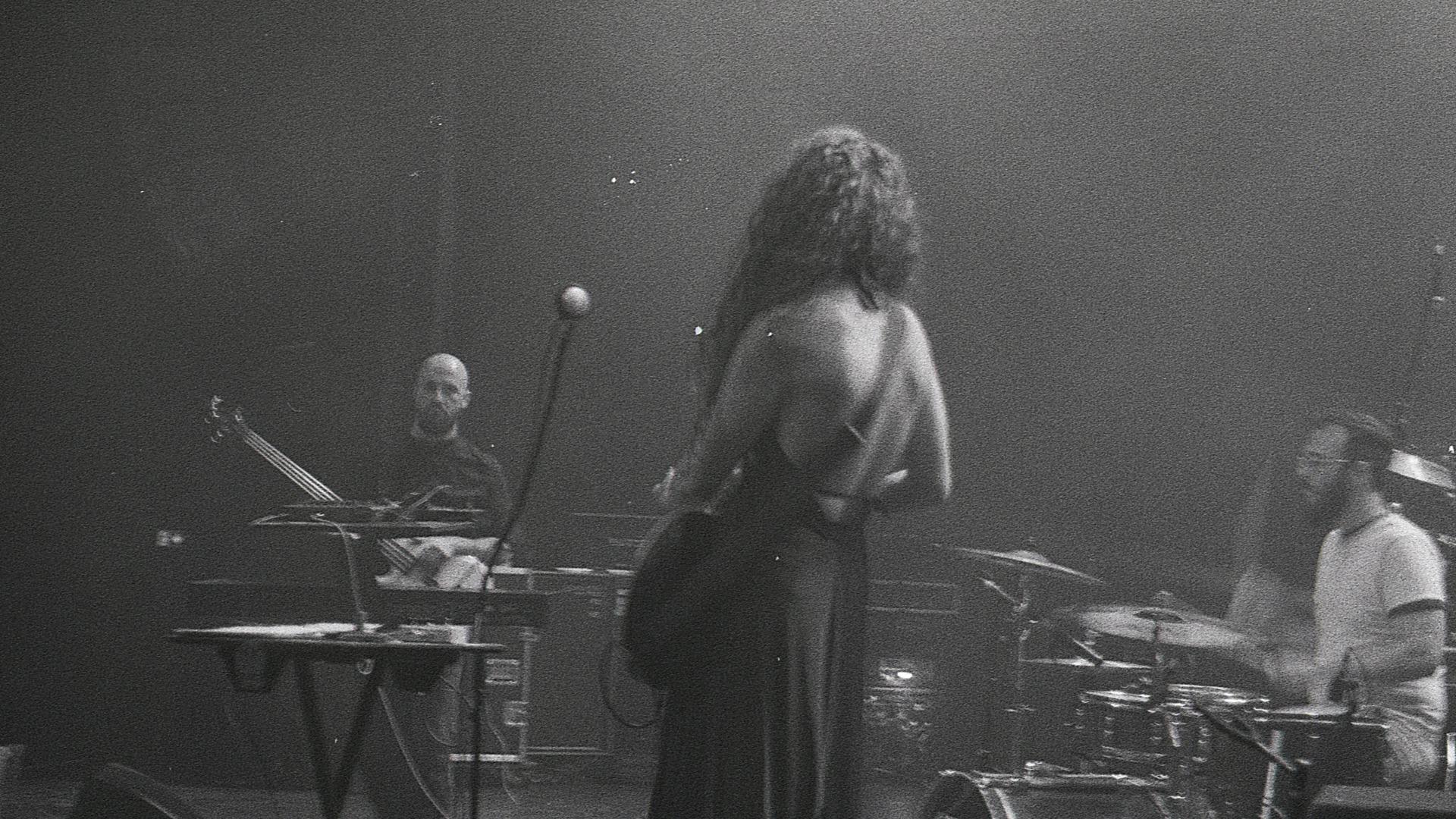
The trio Moving as a Giant was the 2023 discovery of Klubski Maraton (Club Marathon), the annual traveling caravan of promising new musical names across Slovenian clubs organized by Radio Študent. From the dark entrails of pain and anxiety burst a massive body of expressive fusion of repetition, harmony, noise, melody, distortion and scream which, with their debut album released in mid-2024 on the KAPA label, proved to be a striking new force of alternative rock. Slowly rolling rhythms, layers of distortion, effects and noise, seductive melodies and entranced harmonies swallow and enchant us in the magical dance of the charismatic deep alto vocal shaman.
The vocal expression of frontwoman Bojana Pejović is marked by a
devilish voice of wide range, from Diamanda Galás, Chelsea Wolfe, Jarboe,
Siouxsie Sioux, Billie Holiday, Lydia Lunch, PJ Harvey and Beth Gibbons to
Margaret Chardiet, and echoes like the sermons of David Eugene Edwards.
Together with the Kramberger brothers, Primož on bass and synthesizer
and drummer Martin, they serve precisely measured doses of emotional
outpouring and agony that carry us into a world of vertigo, eruptions,
breakdowns and rebirth. Through elastic use of instruments and effective
deployment of a wide array of effects, they weave motifs of psychedelia,
krautrock, noise rock, folk, electronics, soul, blues, industrial and drone
into cohesive songs of cathartically dark rock.
In just over three years, the band has already taken several pivotal
steps that have carried them from obscurity to the very forefront of the
current Slovenian alternative rock scene. After releasing their debut, they
performed last year, among other appearances, at the Ljubljana showcase
festival MENT and at Druga Godba, and in the
second half of this February they are setting off on their first international
tour across Central Europe, which in ten days will cover Austria, the Czech
Republic, Germany, Poland, Serbia, Croatia and Hungary.
Before their departure, we met on the outskirts of Maribor with Bojana Pejović and the Kramberger brothers to talk about the path they have traveled and their expectations ahead of the next step – one that leads them not only out into the world, but also toward their second album.
Let’s start chronologically: when did you find each
other?
Bojana: Which year?!
Primož: 2022?
Bojana: 2022. Was it summer?
Martin: Hmm, winter?!
Primož: We don’t know. But when winter begins, that’s our
time. I assume it was winter. It started like this: Matej Kolmanko knew Bojana
and worked with her on the Gruden project; he knew me from Ethnotrip, where I played piano and he directed our music
videos. At the same time, Matej and I had a parallel project that still
continues, called Transmuranus – we make experimental, very free music. When Matej was looking for
a drummer, I told him that my brother Martin drums well…
Bojana: Let me interrupt so there’s no misunderstanding: when
Gruden fell apart, Matej and I were left alone and for a while we tried working
just the two of us and wondered what we would do. How to continue – should we
invite other people?
Primož: When I was leaving Ethnotrip, I needed new projects,
and the two of them needed a drummer, and when all that came together, there
was a phone call. And we joined forces.
Martin: Primož sent me a video of Bojana singing a song that
we now know under the title Punk, which is on
the album. At that time it was a pure singer-songwriter piece, and it was
precisely on that basis that I joined.
What drew you to join?
Martin: I don’t know, I’m generally open to all kinds of
collaborations. Even now I’m involved in other projects, for example Gnoomes. Recently, at the end of December, I released an EP
on my own and I still plan to publish more. It’s the project Commit Waveform.
So those were the beginnings of what we know today as
Moving as a Giant.
Primož: Some songs that you know under the name Moving as a
Giant came from Bojana’s sketches, and some from Matej’s ideas that we later
developed together. Matej is a multi-artist and his path took him to Australia.
When he was leaving, he told us to keep going and not to wait for him, because
he might stay in Australia. He left us some ideas…
Bojana: …which we reshaped and translated into our own
language.
Martin: In the further work process we refined and finalized
them. For about half of the songs on the first album, Matej was still involved…
Primož: …the other half of the songs are ours.
Bojana, what is it like being in a band with two
brothers?
(laughter)
Bojana: The best part is when they argue. It can be fun.
Primož: Brotherly love is just brotherly love – it transcends
time and space, right.
(laughter)
Martin: It happens that Bojana just listens…
Bojana: …to the friction!
Primož: Through music you can see how tightly connected we
are – that we’re always together and precise like a rhythm machine.
Martin: Even in the way we think.
You were born from the same heart.
Primož: Despite having the same influences, sometimes we’re
like two positive magnets.
Alongside Moving as a Giant you all have side
projects. Where does the need for them come from?
Primož: You shouldn’t restrain creativity. It’s good when all
the valves are open.
Bojana: It’s great to work and create in other projects as
well, because it can flow back. What I mean is that in another project you
discover a trick or a sound that you then bring into the band and use, or vice
versa. It’s like a kind of free-flow creativity between ideas and bands or
projects. Ideas are free by nature, and wherever you as an artist-musician
serve them best, that’s where they belong.
What actually brought you together?
Primož: I don’t know, it’s hard to explain. It would be best
to observe the rehearsals themselves. If someone listened from the outside,
they would definitely think we’re crazy. Sometimes we hit the same sound for
half an hour or more, and other times a song comes out of nothing – from the
first thing we say, that’s it.
Bojana: It doesn’t matter whether we arrived at a song after half an hour or an hour of looping, or whether it came from one of my acoustic sketches that we adapted to our sound. What matters is our output, which the three of us have in abundance.
Your sound is dark and anxious, yet you also have
bright moments that you reach through bursts of rage…
Bojana: Expression is important to me. I don’t sit down with
the intention of writing a sad song or a song about anxiety or any specific
topic. That doesn’t happen. Most lyrics come from observing the world, people,
myself – they get written down more as a feeling. Anxiety is often present
because I live with it.
Martin: That naturally brings darker details, but later, when
Primož joins in with the synthesizer, brighter, more beautiful and more
positive parts emerge.
I was particularly drawn to the Hammond-organ sound,
which in many ways reminds me of soul and rhythm & blues.
Primož: I don’t remember, but maybe it really was Matej’s
original idea that keyboard sound would be the foundation. When I found certain
effects – guitar effects, actually – that have a lot in common with the Hammond
sound, I felt for the first time what guitarists call, “This is my sound!” When
I found it, I was really excited: “Wow, I could listen to this all day.” I’m
classically trained as a pianist, but unlike rock keyboardists who usually come
from The Doors, Deep Purple or House of the Rising Sun by The Animals, I
always listened to guitar music. My top bands are Deftones and System of a
Down, which have nothing to do with Hammond. My Hammond inspirations are not in
Hammond music at all, but more in nu-metal, which was the alternative when I
was in high school.
You use quite a lot of effects and other machinery.
Does technology help you or limit you? After all, abundance can also be
limiting.
Bojana: We try to work in a direction where an individual
song is not dependent on one specific effect. We avoid that, because sooner or
later the effect will break, and it will break. (laughter)
Primož: You need limits to be forced to search and find
creative solutions. I agree with you about abundance – if you have a hundred
pairs of pants available and you don’t like any of them, the problem isn’t the
pants, it’s you. It’s the same with effects; you need limits so you keep
tweaking and searching. If you search, you’ll find.
Martin: We also have some synths that we don’t use at all.
When we reach a dead end and don’t know how to develop something further, we
look for other paths and try to resolve that impasse.
How would you characterize yourselves musically or
genre-wise?
Primož: For me it’s very good hard rock with big balls. We’re
not afraid to slam the table with our music. Someone else might also hear
noise, drone, sludge… What do you two think?
Bojana: It’s hardest for me to say which genre we belong to.
I don’t know. I leave that to the clubs, and most often the label noise rock
appears…
Martin: Noise rock and post-rock. I find it interesting what
others discover in our music and what they compare us to.
Through those comparisons, have you discovered any new
bands?
Primož: Personally, the biggest surprise for me was Bogdan
Benigar’s description for our
performance at Druga Godba, when he compared us to Circuit des
Yeux. I didn’t know that music, and when I went to listen to it, I really
heard Bojana. I said to myself, “Bravo, Bogdan!”
Martin: I actually knew them before, but I never found a
connection to us. I tend to find similarities more in approaches or details.
You certainly have role models who inspire you and
prompt you toward new approaches.
Bojana: That happens naturally. Every musician has certain
influences anchored in their subconscious.
Martin: Each of us has different influences and role models
and listens to our own music, which sometimes overlaps, but we don’t try at all
to deliberately move toward any specific sound.
Which band or performer would you swear by – that
you’d absolutely want to meet, see or hear live?
Bojana: Does it really have to be just one?!
Martin: Right now I’d most like to see YHWH Nailgun, who were
recently in Prague and Slovakia, but I couldn’t make it.
Bojana: I missed Swans and I’d most like to shoot myself for
it…
Primož: And Chelsea Wolfe, right, Bojana?
Bojana: Yes, although she’s not the first that comes to mind.
I’d rather catch PJ Harvey, Nick Cave, 16 Horsepower, Radiohead and Emma Ruth
Rundle. It’s a shamefully short list that I’m trying to compress so I don’t end
up listing everything I listen to. In the end, everything I listen to would be
fun to see live.
Primož: Among the tickets I’ve already bought for my big
concerts this year are Gorillaz, Jack White, David Byrne and Moby. That’s my
plan for this year, although the choice often depends on my daily mood. We
listen to a huge amount of stuff.
How do you listen to music? How do you discover bands?
Martin: I listen at home on speakers or in the car; I use
Spotify and Bandcamp.
Bojana: I usually find a band through a single song, and if
it speaks to me, I listen to it religiously every day, all day, usually for at
least two weeks, until it almost becomes background noise. Then I go check out
everything else. Sometimes in interviews I notice mentioned influences and
listen to those as well.
Martin: Last year two albums impressed me, besides the
already mentioned YHWH Nailgun, also Saya Gray. I listened to that all year. I
want to hear as much music as possible and I try to listen to at least four
albums a day that I haven’t heard before. Those two, however, I keep on loop.
What about you, Primož?
Primož: I’m thinking about how I listen… When something
excites me or when I discover something, I listen to it and analyze every
single noise in the song or on the record. On the last Tool album I found a
track where the cymbal decay is cut off. I really don’t know how that slipped
through with such perfectionists as Tool.
How do you find the Slovenian scene?
Martin: I like that there’s a lot of punk right now. I really
like that.
Primož: I’m always fascinated that we have two million
people, which is nothing compared to the world, yet so many exceptional bands
that you don’t find in huge cities. There isn’t as much creativity as there is
here. But you have to keep searching for it – you have to leave the house and
find those gems on the scene.
Bojana: What I miss on our scene is expression. I don’t mean
a show or spectacle… It’s hard to describe. I miss expression in the sense of
listening to someone, hearing their words and believing them. There’s a lot of
sound concept, a lot of extremely talented instrumentalists, extreme vocals and
so on. I can surrender to all of that and enjoy it, but there isn’t enough
songwriting in the sense of simple singer-songwriter honesty. No matter where
you’re from or what sounds, styles and genres speak to you, when we listen to
someone, we feel whether it comes from the heart or not.
Where do you actually come from – Prekmurje, Murska
Sobota?
(they shake their heads) Not exactly?!
Primož: If the band Moving as a Giant exists anywhere, it
exists in Murska Sobota…
Martin: …that’s where it was formed and where we rehearse.
Bojana: I’m the only one actually from Murska Sobota.
Martin: In the original lineup with Matej there were two
people from Murska Sobota; Primož and I are from Maribor.
Did the Prekmurje Noise Conspiracy movement from the
beginning of the new millennium, or the bands gathered around the God Bless This
Mess label, have any influence on you? Did you even
experience that period?
Bojana: No, I missed all of it. Back then I was still in
school, but I got to know those bands later, in my teenage years. (laughter)
Martin: Matej was part of that with Hexenbrutal.
Primož: At that time I was active in Ethnotrip, and through
Matej I met those people. When I was very young I discovered Psycho-Path and
Hexenbrutal, and the God Bless This Mess label through the Slovenian
alternative magazine RSQ, which seemed amazing to me. Around 2014 I started
going to concerts at MIKK. Moving as a
Giant was formed later than most of that scene.
One of the missions of the Prekmurje Noise Conspiracy
was the transfer of know-how; did you receive any of that in some form?
Primož: Definitely through Matej. With Hexenbrutal he
experienced practically all of Europe. Not only the know-how, but also the DIY
approach – how to tackle things, and above all the mindset that we can
do it, that there are no barriers.

Do you handle the organization of performances and the
entire production yourselves, or do you have some backing or representatives?
Bojana: Now we have a booking agency.
Primož: The tour was arranged by the agency Noise Me, whom we met
last year at MENT.
Martin: More precisely, they contacted us after our
performance at last year’s MENT.
Primož: Exactly one year later, during this year’s MENT,
we’re heading on a European tour. For concerts in Slovenia we still take care
of things ourselves; clubs and organizers contact us directly.
Bojana: With the exception of the Club Marathon.
Primož: In principle we play anywhere if we’re free. We don’t
complicate things. Martin and Bojana take care of the visual and graphic
identity.
Martin: I handle communication with the booker and with the label Kapa Records, while Primož takes care of the financial side.
The Club Marathon catapulted you in 2023 – a year
later you had an album out, two years
later you performed at MENT and Druga Godba. What was the experience of the
Club Marathon like, which introduced you to our club network and the
differences between places, clubs and venues here?
Primož: We gained a sense of playing regularly and also a
slight feeling of being on tour. The pattern kept repeating: travel, arrival at
the venue, soundcheck, break, concert. The Club Marathon is stretched out over
time, but we were forced to rehearse the songs properly, put them on stage and
perform them as a coherent whole.
Martin: That’s exactly the good side of the Club Marathon – a
band gains experience and develops. We experienced it all very positively.
Bojana: I can say that the worse the hole we played in, the
better the gig; the more organized the club with coupons and formalities where
everything ran perfectly, the more boring the show. That’s why I support holes.
(laughter)
Which clubs would you highlight?
Bojana: MKNŽ!
Primož: Every club had its own specifics, but MKNŽ in Ilirska
Bistrica was really wild.
Martin: I was sick at that concert, I had tonsillitis and a
high fever, so from that point of view it wasn’t positive for me. But it really
was an intense concert.
Primož: At TrainStation in Kranj, for
example, there was nobody at the concert…
Bojana: And I was sick then and actually very grateful that
nobody was there.
Primož: …but we had such an incredible sound there that I
can’t forget it.
Martin: We basically had a top-notch rehearsal in front of
the sound technician and the bartender.
Primož: At the Club Marathon finale, Menza pri koritu was packed.
There were people in front of us suffering through our music, and I thought,
“This is great, wow!” Pekarna in Maribor was
also a good experience. In Velenje there were around twenty people…
Martin: …who were all outside by the end of the concert. (laughter)
Bojana: Regardless of how many people are at a concert, in
the end we do this for ourselves.
A band’s true face shows when it plays in front of a
small audience. Why were you overlooked by the Prekmurje label God Bless This
Mess and why did you release the album with Ljubljana’s KAPA Records instead?
Primož: Simply – KAPA was earlier. We really don’t burden
ourselves with the idea that we have to be with God Bless This Mess just
because we create in Prekmurje. We knew bands from KAPA, and when KAPA wrote to
us in time asking if we’d collaborate, we were very happy.
Bojana: It all happened immediately after the Club Marathon.
So the result of the Club Marathon was an album that
you recorded at Radio Študent, which is also the organizer of the Club
Marathon. What was the recording experience like?
Martin: We first recorded at Radio Študent during the Club
Marathon…
Bojana: …and for the compilation we recorded
two songs. Since we had time left, we recorded two or three more, although we
later re-recorded the third one.
Martin: Half of the album had already been recorded…
Bojana: …during the Club Marathon.
Martin: Let me add that for the half-hour concert program at
the Club Marathon we didn’t have enough songs, so we decided that some songs
were basically finished and we played and recorded them even though we could
have kept refining them.
Do you think it’s appropriate to keep polishing a song
all the time?
Bojana: At the time we recorded them, the songs were still
very fresh. If you compare them to today’s versions, you can hear the
differences.
Martin: For example, when we recorded Morning Star, Bojana did a
little trick at one concert toward the end of the Club Marathon that I’m sorry
isn’t on the recording.
Did you at least keep it in the live performance?
Martin: No – or only if we happen to remember it, which
doesn’t happen very often.
(laughter)
Primož: We jam a lot at rehearsals, and if we don’t record
ourselves, great little details get lost. That’s why sometimes, after a minute
and a half, we suddenly stop and say, “Okay, let’s go again – we’re recording!”
That’s the only way an idea doesn’t evaporate and disappear. I also wanted to
say earlier that we really connected well with Radio Študent, to the point that
we recorded with Makis (Ananiadis, editor’s note), who is now going on tour with
us. He’ll be our one-third driver and one-hundred-percent sound engineer. He’ll
fly from Athens to Vienna, where we’ll pick him up and start the tour, which
we’ll finish in Budapest, where he’ll board a plane back to Athens.
Martin: He’ll probably also mix our upcoming material.
Is a new album already on the horizon?
Martin: We’ve already recorded some things. And we also
played two new songs at last year’s MENT. Right now the problem is that we
don’t have enough rehearsals, but we do have concerts and a tour.
(Bojana nods.)
Martin: Time is holding us back more than material.
Primož: Concretely, three songs are already recorded, and the
fourth is at 90 percent. If we compare that to the first album, which had eight
songs, that’s already half an album.
Martin: When we were recording them, two songs still weren’t
finished, so we’re still far from done.
Primož: Our goal is to release a new album in 2027, but we’ll
see if that’s possible because we still have a good number of concerts ahead of
us. After the February tour, another one across Western Europe is planned for
this November.
Martin: Considering what we’ve recorded so far, our goal is quite realistic.
Are you aware of the importance – the turning point –
of the second album?
Bojana: Of course, we know the “second album syndrome.”
Primož: Everything that came with the first album was
completely unexpected for me. It just kept growing. I don’t see the second
album as pressure, and I don’t scare myself with thoughts like, “Oh shit, what
if we mess it up?” I’d rather think, “Oh shit, what if it goes even further?”
I’m really looking forward to it, and I think it will be much more the three
of us than the first one.
Martin: Also because we’ve really tightened up as a band
through all these gigs.
Bojana: It’s hard to predict things, but I believe the second
album will be an upgrade and the result of the lessons we’ve learned. I hope
for the best.
Martin: From the material recorded so far I can say it sounds
more refined and polished – not because we worked more on the songs, but
because of the mileage we’ve accumulated.
Primož: They’re not technically polished. They were made
using the same principle as the first album – live and in a single take,
without overdubs. There’s no heavy production behind them either. I’d describe
them as mature, more mature for recording than the ones we recorded for the
debut.
How would you explain to a fan where the band is
heading with this second album?
Bojana: Even more anxiety. (laughter)
Martin: I haven’t really thought about it. When we were
making the first album, we were thinking only about that. Now it’s different,
we have a tour in between that we’re thinking about a lot, and the album is
being created in parallel. When the tour is over, we’ll dedicate ourselves to
it more.
Primož: It’ll be heavier, with more structure, but also with
beautiful parts.
Martin: Since we have different equipment now, it will also
be a bit different from the debut.
Primož: We’re also approaching some things more boldly
because they received a good response.
Bojana: And we’re more confident in ourselves too.
When did you start to feel like a real band? Before
stepping onto concert stages, or only once you started performing?
Martin: What do you think?
Bojana: In my opinion, on stage. Before that there was
anticipation and excitement that this might be cool, but only on stage do you
really lock in, connect, and get used to each other.
Primož: Probably true. When we were creating our first songs,
on the way home I kept genuinely wondering whether anyone would even like this.
Then, before the Club Marathon, we performed at Gustaf in Maribor, where a sound engineer who had seen and
heard everything in his life came up to us and simply said, “Wow.” That was the
first time I felt we might actually be on the right path.
Martin: I liked the motivation and drive from the very
beginning. At the first rehearsal, when I didn’t really know Bojana or Matej
Kolmanko yet, we already created one song.
Bojana: A band is work!
Primož: Exactly, you spend more time in the rehearsal space
than on stage. The space, rehearsals, talking, hanging out, that’s what makes a
band. We don’t work on being likable; we work on what we like. We don’t adapt.
Maybe that’s a bit selfish, but it’s our artistic freedom.
You use different instruments that you play as needed,
for example harmonica — and through a Green Bullet…
Martin: We had the Green Bullet even before the harmonica.
Bojana: That Green Bullet microphone I have is actually
intended for harmonica, so sooner or later it had to happen that I’d actually
start using it for harmonica, which I then went out and bought.
Martin: The first one you borrowed from the neighbor in the
rehearsal space.
Primož: I’m not sure if it’s the same song, but there was an
idea for Bojana to play kalimba into the Green Bullet.
Martin: It’s the same song, yes.
Bojana: After the harmonica, we tried everything else with
that microphone too.
(laughter)
Where does the need to search for different, unusual
sounds come from?
Primož: Since I play bass, I’ll explain how we came to it.
While searching for the feeling of riffing on a single note, which I simply
couldn’t achieve with a synth, because there you just hold a tone and that’s it
– we ended up with a bass that I went and bought mainly because it was being
sold together with a case for a hundred euros. The girl who sold it to me kept
apologizing for the bad strings and saying it had been used for folk music, but
that was fine with me – the main thing was that it growled.
Martin: I personally have the fewest instruments, but I have a different drum setup, which forces me to step outside established logic. At the beginning, for example, I tried playing without a ride cymbal and searched for a different path. In those ways you’re forced to find new solutions.
Have you ever thought about making your own,
self-built instruments? Maybe you’re already using one?
Primož: You came closest to that, Martin.
Martin: I experimented a bit with making effects, and when I
made one, I also quickly burned it out. So that was the end of that.
Bojana, when did you discover the depth of your voice?
Bojana: I can actually say quite precisely – when I was
eighteen or nineteen, my range expanded. I found a recording of myself from
when I was seventeen, made with one of the many cover bands I had; I think it
was the second one. And when, after who knows how many years, I heard what my
voice sounded like at seventeen, it was… You could hear that I hadn’t smoked
that many cigarettes yet. Of course it was higher. At nineteen it became
deeper. I’ve been singing my whole life, though – at home they used to say I
hummed and swayed strangely to music before I even really spoke. That period
lasted quite a while. So I discovered my singing voice before my speaking one.
You can still see that today, since I’m rather a person of few words, while my
vocal range is definitely more developed. (laughter)
How has the development of Moving as a Giant gone and
where is it going?
Primož: We don’t have a specific final goal; we take
everything as a new step. For example, the Club Marathon wasn’t the goal, it
was a step. Looking back, that step led to a label, that led to an album.
Performing at Druga Godba was a huge checkmark for me – when I was walking up
the stairs onto the Kino Šiška stage, I got goosebumps, not to mention that we
were the opening act for Altın Gün. Mind-blowing!
My little kids listen to them – my daughter, who’s about to turn ten, reads Adrian
Mole and listens to Altın Gün. Where do you see that?
Did you bring her to the concert?
Primož: No, unfortunately. My wife was in Portugal, and if I
had brought her, I would’ve had to deal with all that, so I decided against it.
Even though performing at Druga Godba was a huge checkmark, it was still only a
step forward. It’ll sound philosophical: if you want something, life will give
it to you…
Bojana: …if you work for it.
Primož: Exactly, if you work for it! My first real band had
the goal of recording an album, and once we recorded it, we fell apart. That’s
also why I don’t focus on that anymore. Now process goals are important to us.
Our goal, for example, is 35 concerts a year – that’s our path.
All of this brings new obligations, responsibilities,
additional worries. How do you handle it?
Primož: With brotherly love.
(laughter)
Primož: We learn something from every situation. When we mess
up, we try to take from it how to get through a similar situation better next
time.
Martin: For example, when we printed T-shirts for the first
time, we received them the day after the official album release. That
was quite a screw-up.
How important is merchandise to you?
Martin: We’ll probably really see that on this European tour.
Primož: I find it indescribably cool when we go somewhere to
play and people come to our concert wearing our shirts. That’s truly amazing to
me. We made it. Personally, I like buying merch from bands because the
money stays with them. Besides listening to them and spreading their presence,
I can also support them directly. So I’m extremely happy if people have that
same attitude toward us.
How much have Moving as a Giant played abroad so far?
And what’s the longest you’ve been together on the road from concert to
concert?
Martin: Not much, but we did drive to Belgrade in a vintage
car that could go at most 90 km/h, so we spent quite a lot of time together in
it.
(laughter)
Bojana: An old police vintage car whose back doors didn’t
work.
Primož: With Moving as a Giant, we were together the longest
when, after performing at last year’s Druga Godba, we had a concert the very
next day in Zabok, Croatia. This first European tour will be quite a test for
us whether we can even stand ten days with each other.
Bojana: Will brotherly love carry us through the tour?!
(laughter)
Martin: Makis will be with us, so he might step in as a
mediator.
(laughter)
So in the second half of February you’re heading off
on your first European tour. What feelings are going through you before the
trip?
Primož: Bojana is recording an album with My Secret Grind
Project before that.
Bojana: That’s true, Matej Kolmanko and I are going to record
an EP, so my head is in that right now. As for the tour, I try not to build any
real expectations, or at least I try not to. I listen to a lot of stories from
other bands who’ve already toured abroad, and I’m excited. I think when we come
back, it will be sad and we’ll want to go back again, but also happy because of
the experience.
Martin: It will definitely be joyful.
Safe travels!
Author: Igor Bašin
Cover photo credit: Jure Radoš