


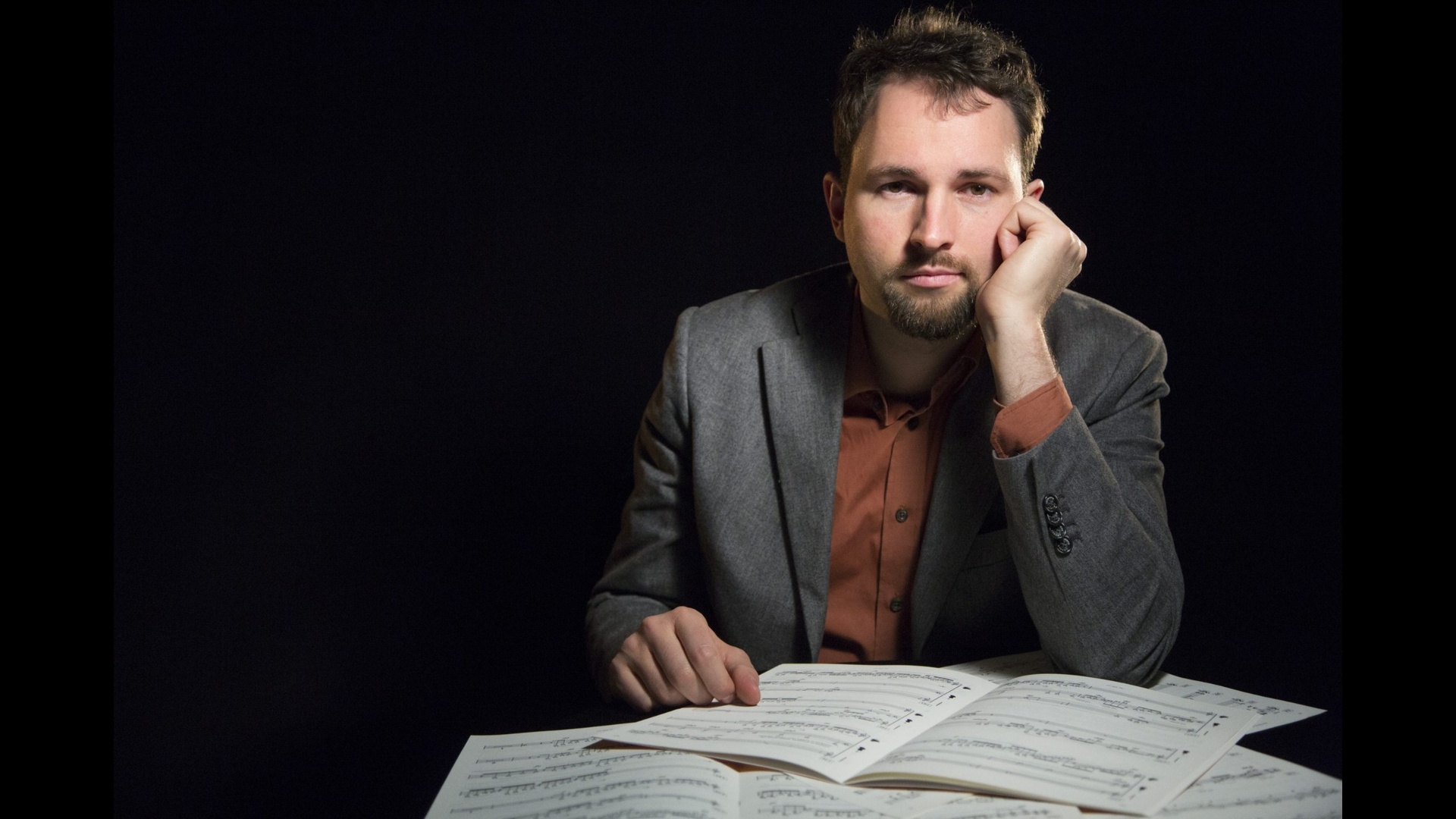
[Interview] Vito Žuraj on International Recognition for Recording of the Year
At the mention of Vito Žuraj’s name, all attention immediately turns to him and his work, as he has already achieved the highest international recognition and appears on the world’s leading stages. His oeuvre encompasses orchestral, chamber, and choral music, as well as solo and electronic music, in addition to opera.
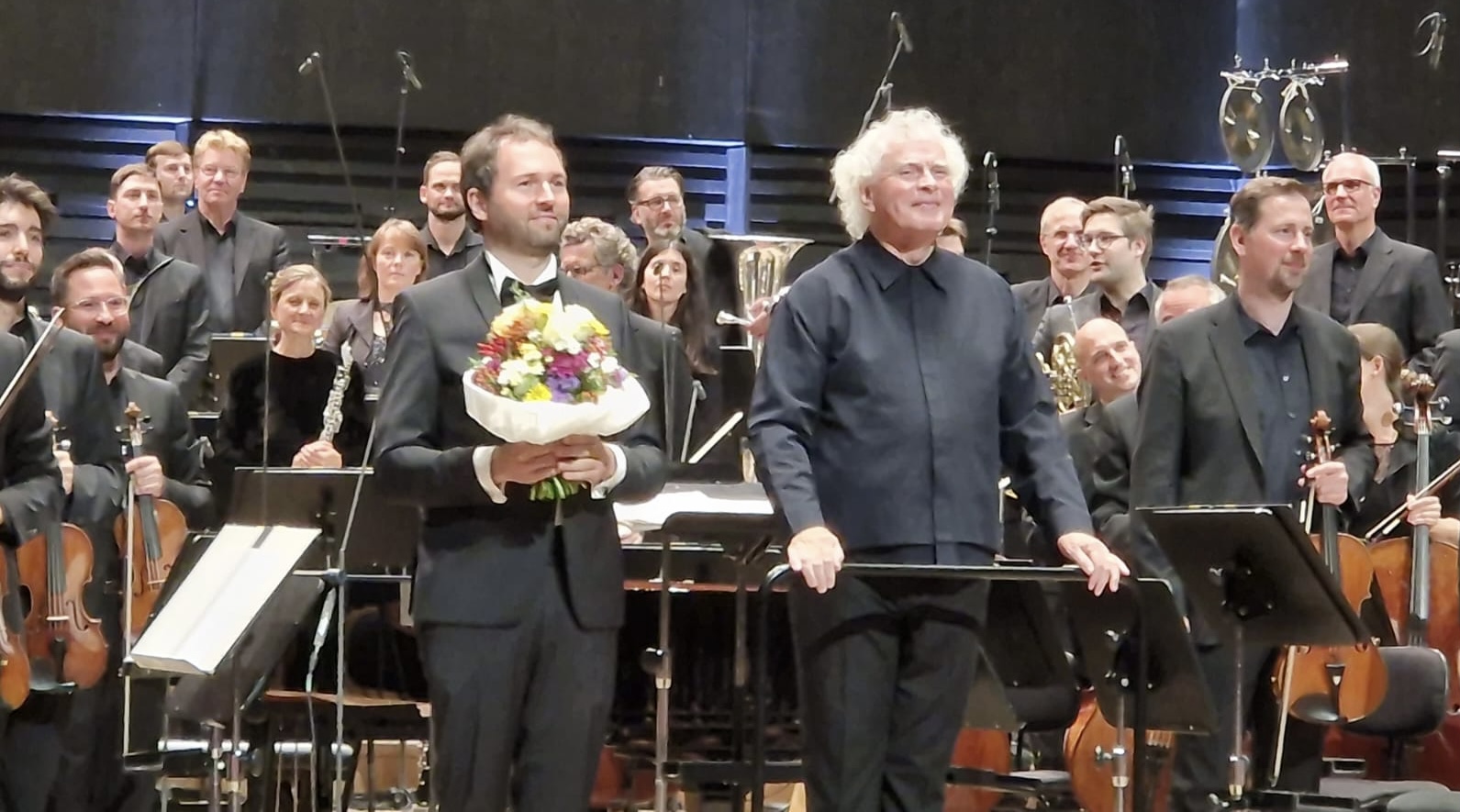
Vito Žuraj is the first Slovenian composer from whom the renowned Berlin Philharmonic commissioned a new symphonic work. Among other distinctions, he has received the Stuttgart Composition Prize and the Prešeren Fund Award, worked as an artist-in-residence at Villa Massimo in Rome and Villa Concordia in Bamberg, and received a scholarship from the Berlin Academy of Arts. His most recent successes include collaboration with Sir Simon Rattle and the Bavarian Radio Symphony Orchestra in Munich.
In 2025, your composition Automatones
appeared on a BR
Klassik CD together with Berio’s Coro, performed by
the Bavarian Radio Symphony Orchestra under Sir Simon Rattle. This is an
exceptionally high-profile event, and the classical music magazine Crescendo
selected the album as Recording of the Year 2025. It is the 50th anniversary
release in Bavarian Radio’s BR Musica Viva series. The album presents two
independent creative personalities, with you being seen as the one pointing
toward the future. It is a project that opens questions about the continuity of
contemporary music, the relationship between the historical avant-garde and
today’s compositional practices, and the role of the performer as co-creator of
a musical work. How do you yourself view this juxtaposition?
The project was initially conceived somewhat
differently, namely as a commission for a new work in the Musica Viva concert
series of the Bavarian Radio Symphony Orchestra in Munich, a seven-concert
program devoted exclusively to new music. At first, I had discussions about a
new piece for two singers and orchestra, but then Sir Simon Rattle became chief
conductor of the orchestra, and the director of the concert series advised me
to write a work for large symphony orchestra and suggested linking it with Luciano
Berio’s Coro, whose ensemble already includes many singers. When
composing the piece, I was not bound to Berio; I was completely free in terms
of thematic material. The fact that the commission came about was certainly
helped by my receiving the Claudio Abbado Composition Prize in 2017, awarded by
the Karajan Academy of the Berlin Philharmonic. At that time, Sir Simon Rattle
was their chief conductor and attended the rehearsal of my piece for the
prizewinners’ concert. That is how our collaboration began.
I would like to ask how the composition itself is
organized. I once attended a lecture about time in music and physical time and
the differences between them, given at the Tempo Reale Institute by Jacopo
Baboni Schilingi. How do you see time in music?
The composition deals with the theme of the inventor
Daedalus from ancient Greece, which was suggested to me by the Slovenian poet Aleš
Šteger. Among other things, Daedalus created so-called automatons – statues
with built-in mechanisms that could move on their own. This served as my
guideline for illustrating different modes of movement in terms of contrasting
motoric structures, such as rhythmic regularity, the illusion of endless
acceleration, and chords that gradually arpeggiate. At that time I had just
completed the opera Razcvet (Blossoming) and used some of its
material in a symphonic way. I found a model for the structure of the working
process in Sergei Prokofiev’s Symphony No. 3, in which the composer
rearranged material from his opera The Fiery Angel. He collected
materials one after another, whereas I, in contrast, layered them on top of
each other. Certain elements from the opera may perhaps be recognized in Automatones,
but formally it is an entirely different work.
Automatones draws
inspiration from the creatures of the smith Hephaestus and the master Daedalus,
said to be capable of feeling and thinking like humans, which causes Heracles,
upon visiting Daedalus’s workshop, to destroy one of them, convinced he has
been attacked by a person. In this myth you found a parallel to artificial
intelligence, which for now still does not feel, but you wonder whether this is
merely a matter of time. Did you ever accept the challenge of artificial
intelligence while composing? Do you use any specific algorithmic approaches in
Automatones?
Automatons are a kind of predecessor of artificial
intelligence – statues that could move on their own and thus assumed
responsibility for their movement. If an algorithm begins to generate on its
own, be it music or text, then we enter the realm of artificial intelligence.
What exactly does it mean if artificial intelligence learns from what already
exists and then reinterprets it? This is most often used in entertainment music
or background music and will probably drastically change the way copyright is handled.
Of course, these are segments where it is financially worthwhile. In
contemporary music, which is a forge of new ideas, things are different,
because artificial intelligence does not invent something new but merely
combines what already exists. I should emphasize that I did not use artificial
intelligence in the creation of Automatones.
Was Automatones commissioned by the Bavarian
Radio Symphony Orchestra?
Yes, it was also the first commission of the Musica
Viva cycle since Sir Simon Rattle took over as chief conductor of the Bavarian
Radio Symphony Orchestra. When such a renowned conductor approaches the
performance of a new work, it attracts an entirely different level of public
attention.
Are you interested in exploring the dialogue between
historical avant-gardes and contemporary practices? How much does this touch
your creative process? With Berio, was it about influence or connection?
As far as Berio is concerned, on my part it is a
matter of great respect for this important artist, but my composition has no
substantive connection with him. Regarding the link with Prokofiev, it was
strictly a formal experiment; stylistically there is no direct correspondence.
You have developed a superbly crafted musical language
in which every gesture is the result of careful reflection on how sound is
produced, how it spreads, and how it transforms. How would you define your
style?
When a composer is part of a certain group that deals with something specific, they identify with it. This can be seen in movements such as minimalism or spectral music, where the thematic focus is very clearly defined. I do not identify with any movement; I have never written a manifesto. I build my own language based on my life experiences. What it is ultimately called does not concern me.
© Andreja Šutar / Vito Žuraj personal archive
You are a top-level creator whose works are performed
at prestigious venues and by the best performers. You once said: “In Ensemble
Modern, the brass forms the core, so the strings saw a bit more. Klangforum
Wien is based on strings, to which the other instruments dynamically adapt. The
Scharoun Ensemble consists of Berlin Philharmonic musicians with an
exceptionally beautifully crafted classical sound.” Based on these
characteristics, you chose a satirical, rougher theme for Ensemble Modern,
focused on delicate colour nuances for Klangforum Wien, and in the piece for
the Scharoun Ensemble the elegance of sound was more important than rhythmic
peculiarities. Yet you remain true to yourself. How do you organize your
compositional process?
If we take these characteristics of ensembles as a
kind of starting point, the interpretation of works will probably differ,
though not necessarily. Each musician represents a very unique inspiration to
me, and that is also why writing for different ensembles results in different
musical works.
How do you remain true to yourself amid all these
connections? Despite meeting great personalities, you yourself remain a strong
personality.
It is not about bowing to someone or refusing any
influence, because it is a lifelong process of shaping an artist. Just look at
how different Stravinsky’s early works, such as The Firebird, are from
his late works. Change is the only constant in life. I always advise my
students to change environments when continuing their studies, choosing one
that offers an even greater flow of information. A lot happens in Ljubljana – we
have three symphony orchestras, we have the Ljubljana Festival; for a city of
three hundred thousand people, this is a very intense musical environment. The
fact that students at the Academy of Music of the University of Ljubljana
already have the opportunity to collaborate with professional orchestras during
their studies is a world-class uniqueness that should be highly appreciated. It
was also an important springboard for me. Of course, students at universities
in Western Europe will have much faster transport connections to artistic centres
such as Paris and Berlin, and only in such cultural exchange can an artist
truly mature. I believe half of success depends on the university and half on
the cultural environment.
On the one hand we are global, but some environments
are probably still more traditional or local. Is the professor’s influence on
the student noticeable – does it
unintentionally transfer, or does the student shape their own path? Is it a
very subtle relationship?
It is very subtle and highly dependent on the
individual. When I was a student myself, and now as a professor observing
colleagues and students, I see that everyone reacts in their own way. A
student’s music may initially seem similar to the professor’s, but later it
will develop in its own direction; someone else may immediately go in a
completely different direction, and the professor accompanies them and answers
questions. When I studied in Karlsruhe with Professor Wolfgang Rihm,
during the first three or four months we asked each other many questions so I
could sense how he presented material and he could see what interested me. He
never forced students to write in a certain style; he allowed everyone to
develop in the direction that interested them. His breadth is illustrated by
the fact that he highlighted the analysis of works by Helmut Lachenmann – stylistically
his greatest antipode – in class, fully aware of how
important that music is for artistic development. How students use such
information is up to them.
In a way, it is precisely difference that enables a
different perspective. A Japanese composer, for instance, has a different view
of composition than a European one …
Indeed. In Professor Rihm’s class there were
composition students of many nationalities – besides various
Europeans also Chinese, Koreans, Japanese, and Americans. Such exchange is
truly enriching.
How would you define Ljubljana in relation to Europe
or the rest of the world? We have the SOS concert series, the New Music Forum,
formerly the Slowind Festival, and so on.
A great deal always depends on individuals who invest
extraordinary energy in successfully transferring current events across the
Alps to Slovenia. The best example is the SOS concert series of the Slovenian
Philharmonic; Matej Šarc is the one who, in addition to thoughtful
program design, also brings top conductors to Slovenia. I would like to
highlight the first Slovenian performance of Grisey’s cycle Les espaces
acoustiques, conducted by Bas Wiegers. In my opinion, this
interpretation ranks among the very best. The Slovenian Philharmonic Orchestra
is truly capable of playing at the highest level, of course with a
conductor who motivates the musicians and draws the maximum from them, which we
have already seen at many classical concerts. They also had an extremely
successful Asian tour. I would also like to mention the historic concert
performance of Tosca at the Ljubljana Festival with the SNG
Maribor Orchestra and top soloists such as Sondra Radvanovsky,
Bryn Terfel, and Freddie De Tommaso. The orchestra sounded like the
Metropolitan Opera Orchestra, and we heard soloists of the same calibre – an
unforgettable and unrepeatable experience for me. I am convinced the audience
knows how to appreciate this; the question is what international resonance such
an event has when it takes place in Slovenia. Geographical remoteness and
limited transport connections, especially air travel, do not work in our favour.
Fortunately, we live in the digital age and good recordings circulate quickly.
Your opera Razcvet was truly an exceptional
event. Do you have any new plans in this regard?
Opera is a large form and something completely
different from writing concert music. Each composer senses for themselves how
productive they can be at a given moment. I am not among those who write a new
opera every year. I need more time to develop material so I can reach an
original concept and a different sound. It would be difficult to expect me to
write a new opera already next year, but I do have some ideas and plans. I can
only reveal that it will involve a collaboration with a renowned Slovenian writer.
Has the new CD opened any new paths for you? As the
first Slovenian, you are nominated for the German Music Authors’ Prize in the
category of music-theatre art, to be presented in February. How did this
nomination come about?
My opera Razcvet was declared Opera Premiere of
the Year, which among other things led to a Frankfurt revival and the Slovenian
premiere. I assume this success reached those who decide on nominations.
Where do you find interlocutors – at
home or abroad? Does it depend on the person?
For new works, mostly abroad. For a long time I worked with an agency in Berlin, and regardless of that I accumulated the most contacts in Germany, since I studied there and lived there for a long time. But it is always especially beautiful to experience a performance of my music in my homeland.
Lea Brinovec
Cover photo credit: © Tone Stojko / Vito Žuraj personal archive